A sophisticated yet versatile package, Mojave is a contemporary jazz quartet based in Auckland. Formed in 2000, Mojave features the unique sound of jazz flute within the format of a jazz quartet. Our music is expertly performed by an ensemble of high calibre, experienced professional musicians, who have the ability to read and adapt to the musical ambience of any event or function. The music explores jazz, Latin, blues, reggae, lounge and other energetic grooves exciting new original material, as well as favourite jazz standards as featured on our new album ‘Well dressed Standards’ released in 2009.
Several publications have reviewed our previous album ‘Ristretto’ favourably including New Zealand Musician Magazine “one of the best albums I’ve heard this year.”
Mojave performs regularly in Auckland at jazz venues and festival performances all around New Zealand are a regular feature. Highlights include a sell out concert at The National Jazz Festival in Tauranga 2007, as well as recent popular performances at Nelson Jazz Festival and Mission Bay Jazz and Blues Festival in 2009. I am playing with them at the Coopers Creek venue, 1-4pm on 13th February 2011.
Bring your family & friends down to have fun in the autumn sun.
A afternoon of great music, good food and sweet vibes.
Bands playing throughout the day. I believe BSD is headlining this event.
Line-up!
BlackSandDiva
Twin Coast
The Westwoods
Jess David
The Stickmen
Clam
The K.J’s
Shimian
Canis
Barn Shout
Half-blood Defiance
New Natives
Zig Zags
James Kahu
& Shady Brain Farm
Thanks for all of those who supported Kotahitangata last night. I found out that we managed to raise 40K for the appeal, it was a fun do too….
In the wake of Christchurch’s devastating earthquake, Heaps of People present the “Kotahitangata (One People)” concert for the “NZ Red Cross 2011 Earthquake Appeal”.
Tix from http://www.eventfinder.co.nz/2011/feb/freemans-bay/kotahitangata-one-people
Feat. Sola Rosa, King Kapisi, Homebrew, LA Mitchell, Anna Coddington, Coast, The Midnights, LatinAotearoa (Bobby Brazuka, Jennifer Zea & Isaac Aesili), Recloose, The Turnaround (Manuel Bundy, Cian, Submariner) & special guests.
100% of all proceeds will go to Red Cross New Zealand to aid their ongoing efforts to support those affected by the quake.
No cost was incurred in the creation of the event with the complete line-up performing free of charge.
Likewise, Loop, Finest Ego, Sale St, Wavefront Audio, Eventfinder, Kiwi FM, George FM, Base FM, Radio Ponsonby, Conch, Rise Graphics, PA Sound, The Production Company, Robert Barclay Limited, have all generously donated their services.
Doors open at 4PM and there will be a variety of auctions running during the day to also raise money for the cause.
Tickets are $25 from Eventfinder and gig-goers are also required to give a donation of their choice on arrival – anything from $1 to $1000 – it is all greatly appreciated.
Ticket links are available from:
http://www.eventfinder.co.nz/2011/feb/freemans-bay/kotahitangata-one-people
************************************
AUCTION AT 7.40PM
************************************
1. 1 pair of Onitsuka Tiger Shoes from Texas Radio
2. Jameson Jam Sessions VIP package for 4 (feat. Tahuna Breaks + at Sale St on April 7) & a bottle of Jameson 18 Yr Reserve
3. His & Hers Bendon prize pack V1
4. His & Hers Bendon prize pack V2
5. Rotorua Luxury Escape Package
6. 6 Moa Methode & 6 Moa St Joesphs 1500mL Magnums
7. 2 cases Merlot Franc Malbec 2007 and 2 cases of Hawkes Bay Pinot Gris 2010 from Black Barn Vineyards (24 bottles total)
8. Basket of tasty morsels from Harvest Wholefoods
9. WOMAD Festival Package for 2
10. Huffer $500 Magic Voucher (online store)
11. Wanaka Escape Package for 2 including accommodation, mountain passes, gear hire & transfers
12. 1 years supply of Supreme Coffee delivered weekly
13. EntireLOOP catalogue & a Lifetime Pass to all Loop shows
14. Artwork “Koru – New Beginnings” by Lisa Turley
15. Sale St Velvet Room Experience for 50 people worth $1000+
16. Return trip for 2 to Rarotonga on Air NZ including 5 nights luxury accommodation
17. ACDC graphic motorcycle helmet signed by ACDC. Only one in the world! Plus very rare Black Ice Tour Jacket (size XL) and a ACDC Black Ice Tour AAA pass thanks to Tony Flett. $5000 reserve
************************************
SET TIMES – PM
************************************
4.00 – Submariner
4.30 – LatinAotearoa
5.00 – Submariner
5.15 – LA Mitchell
5.45 – Nacoa
6.00 – Anna Coddington
6.40 – Mikee
6.55 – Coast
7.35 – Angels
7.40 – Auction
8.30 – The Midnights
9.15 – Cian
9.30 – Sola Rosa
10.15 – Cian
10.30 – King Kapisi
11.10 – Manuel Bundy
11.30 – Homebrew
12.00 – Recloose…
I am lucky enough to be one of the performers at Ponsonby’s ‘Prohibition’ Restaurant. Currently I play with Aaron Coddel (Bass) every Tuesday night from 7-10pm, Kim Patterson (Trumpet) on a Thursday evening and with Georgia Wood (Vox) on Fridays 7.30-10.30pm. If you are interested in afternoon ‘Low Tea’ then you can also hear my solo piano stylings every Saturday afternoon 12.30-3.30pm.
This is a VERY stylish restaurant, the owners have an impeccable eye for detail, the food and wine is fantastic and the entertainment isn’t to shabby either!! A review is included at the bottom of this post, thanks.
Prohibition – Five course whisky tasting dinner
Due to a dalliance with a whisky-drinking Thai in Auckland and an overdose of Thai whisky in Koh Samui over ten years ago, Ive shied away from the drink. There are so many other options out there, most of which include a drink made from grapes, with which I prefer to whet the palate when eating a delicious meal. However, when you are invited to an event with a group of good friends for a special occasion, its not on to allow ones old prejudices decide the flavour of the evening.
So it was with a small amount of trepidation, whinging and drama that saw me drawing up to Prohibition Restaurant on Ponsonby Road for a five course dinner with matching whisky. Prohibition itself was in my mind a very favourable venue for an affair such as this, and since I had heard the French head chef Denis Baudet had packed his bags at Rocco and moved all the way across the road to this outrageous place, I was dead keen for visit.
Owners South African Colin Gardner (pictured in the red lounge) and Russian Eduard Gorin opened Prohibitions doors in 2008, and the boys are as outlandish and alternative as the restaurant they have created. The premise is that you step through the doors and into the 1920’s prohibition era – the entire get-up of this restaurant and the staff within a thusly themed (who doesnt like a man in uniform?). What they have done is completely out of the realm of a normal dining-out experience, and they have such heart for the idea that they are only ever improving on it.
We were whisked upstairs to a crowded large dining room and sat at one of the five six-person tables. Here is a cute catch: we had unknowns sit with us which is such a lovely thing, and SO not normal in an upper class restaurant where pretention usually rules. However, this was no ordinary dinner. The patron was Bart from The Whisky Shop in the Elliot Stables, who ushered us through the info and tastes of the individual whiskies before the dishes came out. I gave it a go with the whisky but also ordered a bottle of Kennedy Point Sauvignon Blanc to placate the ever-present wine craving.
Bart explained that 17 whiskies (out of the 550 he supplies at the shop) were brought into the restaurant and there was a tasting to decide on the final five for the dinner. Denis (chef) then took these whiskies to the kitchen and sculpted each dish around them. The food was terribly good and well beyond my expectations.
The first course was simply ingenious. Huge Clevedon oysters sat in a cucumber sea-salt jelly with spoonfuls of sweet roasted scallops covered in wasabi mayonnaise and shredded nori. The seafood was perfection, the flavours of each component strong and so different as to balance beautifully. It was of course very Japanese in flavour, fresh and crisp.
The pan-fried caramelised half poussin with carrot remoulade, shitake mushrooms and chestnuts was covered in a thick red wine sauce, and was sweet and morish. At this point the matching whisky or a Dalmore 12 year old St Etienne Rum finish made me very aware that I had a fiery belly and numb lips. From this point on I watered down my whiskey (this is totally acceptable so said Bart).
The roasted hapuka with buttered leeks and black pudding was another stunner. The fish was succulent and moist, the cooking done with masterful skill, at the exact point of not being raw or over cooked. The black pudding was a great contrasting flavour, bacony and solid and the leeks a favourable soapy come back. On the verge of being happily full we encountered the cheese course. I have never in my life experiences cheeses like it. A Delice de Borgogne was served as soft as butter but sour like a feta. It was strong and creamy and when I saw plates being taken away with morsels left I swiped them back and lapped it up.
Overwhelmed by the tastes, yumminess, lovely people around, whiskey and wine I thought that must be it! Enough. But no, the dessert came out. Again, the best sticky date pudding Ive ever encountered. Created in a way that mimics the LA airport, it had a delicious crispy toffee exterior, was not doughy inside and sat happily furnished with vanilla ice cream and pistachio nuts.
Quickly polishing that off, the table became ensconced in deep discussion over a bottle or carafe of Pinot and a game of cards to finish the night; the setting was too lovely to leave. But we realised the room was emptying so we joined the happy queue to pay, glad of the lovely night with delightful food and an over indulgence of good alcohol.
-Master Bite
PRICE: Five course whisky tasting dinner $135
BOTTOM LINE: This is really a different dining experience. Prepare for a great, delicious and fantastical night.
In this unique concert, twelve of New Zealand’s best contemporary recording artists come together for four very special nights to perform songs inspired by the rare and moving words of iconic Maori writer Witi Ihimaera. From King Kapisi to Horomona Horo, Teremoana Rapley to SJD, amazing Kiwi musos create songs with lyrics by Ihimaera.
Setting his words in a wide range of styles, this concert showcases Ihimaera’s distinctive and powerful evocations of life in Aotearoa and the impressive diversity of New Zealand music.
In its fusion of great literature and outstanding musical talent, Ihimaera is a phenomenal feat of artistry. Narrated by star of Outrageous Fortune, Kirk Torrance, and produced by Charlotte Yates, the creator of Baxter (2000) and Tuwhare (2006), Ihimaera gives the author’s words an exciting new wardrobe of sound.
A special Auckland Arts Festival commission, Ihimaera receives its world-premiere in 2011. A CD of songs from the show is set to be released by Universal Music NZ in February 2011.
Artists featured include Lupin (Victoria Girling-Butcher), LA Mitchell, Unitone Hi Fi, Ruia Aperahama, Horomona Horo, King Kapisi, Warren Maxwell, Ariana Tikao, The Twinks (Milan Borich and Tim Arnold ex-PLUTO), SJD, Teremoana Rapley and Charlotte Yates.
Thu3 Mar 8pm GH
Fri4 Mar 8pm GET
Sat5 Mar 8pm GET
Great Hall, Auckland Town Hall (GH) & Genesis Energy Theatre, TelstraClear Pacific Events Centre, Manukau (GET)
Lucky to be performing as part of BlackSandDiva on the Beach Stage, some fresh tunes and musical spinach, be there or feel sad! Check out the line up for the festival, it looks pretty exciting, some interesting new acts.
Below the link is a great article on a study into brain adaptation, this could be applied to music practise maybe? The book is written by Norman Doidge (MD) and may well be worth a read, the link is below, thanks!
An important example of neuroplasticity is how humans gain skills. Doidge presents an experiment performed by Pascual Leone in which he mapped the brains of blind people learning to read Braille. Braille reading is a motor activity, which involves scanning with a reading finger, and a sensory activity, which involves feeling the raised bumps. The brain maintains a representation of these sensory and motor aspects, which are located in different cortices. The blind subjects practiced two hours a day, Monday through Friday, with an hour of homework. The mapping of their brains took place on Monday, after the weekend, and Friday, immediately after their week cram. What the scans ultimately showed is that the maps dramatically increased in size on Friday scans but returned to a “baseline” size on the following Monday. It took 6 months for the baseline Monday map to gradually increase and by 10 months they plateaued. After the blind subjects took a two month break, they were remapped, and their maps were unchanged from their last Monday mapping. What this shows is that long lasting changes as the result of skill learning took 10 months of repeated practice. The reason why short-term improvements were made based on the Friday mappings, but eventually disappeared, is the result of the type of neuronal connections that were taking place. The Friday mappings were the result of the strengthening of existing neuronal connections. Monday mappings, though showing little progress initially and plateauing at ten months, were the result of the creation of new neural connections.
Tom Dennison, Jason Orme and Mira Lacey form the other sides of the square on Saturday 29th January @ 2.30pm and Monday 31st January @ 12.30pm. See you there if you dare!!
The 2011 Auckland Seafood Festival promises to be bigger and better than ever and the music is no exception with over forty hours of sounds across four stages including an acoustic stage in the intimate setting of the Oyster & Champagne marquee. This year we have more stages and a wider range of top quality acts.
Whether it’s rock, jazz, soul, country, blues, hip hop, folk, or a bit of ‘mod’ from the 60’s. From great headline acts like Greg Johnson to old favourite Peter Urlich or new group, The Con-Ray’s, who feature some of New Zealand’s most iconic performers, we have something for everyone.
The festival music program runs from 12 – 7pm every day so whenever you visit the festival you can enjoy toe-tapping upbeat sounds on the band stages or relax to the smoother sounds of the acoustic stage. The music line-up on our main music stage features some of New Zealand’s most well known acts inclusing Greg Johnson, Peter Urlich, Nairobi Trio, The DeSotos, Hamish Polson and The Red Suns.
On the other stages we showcase some of Auckland’s best talent, including; Leza Corban and Aqstik Soul, Chet O’Connell Trio, The Hand – featuring Donald Reid, Motor City Family Funk, Reb Fountain, Danny McCrum in The Buskers Duo, Sarah Spicer Band, The Samsom Nacey Haines Trio and many more.
Want plenty of seafood with great NZ music every day? Then the Auckland Seafood Festival over Anniversary Weekend is the place to be.
I thought I would post this review as it’s the first review I have ever had, and it’s quite complimentary! Thanks Sunday Star Times, Auckland.
“Kiwi Mark Baynes is one of the most exciting jazz pianists to come along since Mike Nock. His soulful side, featuring a cast including tragically under-exposed vocalist Georgia Wood, is funky without getting stuck in a groove. For jazz fans his new Ironic Trio album In Song is also essential listening.”
Scenes from an Italian Restaurant – Billy Joel, 4 piece arrangement comprising of keys 2, bass, drums and horn. I did this one for a singer/pianist on the Seabourn Legend cruise ship.
This is a 7 piece arrangement of ‘Country’ found on Keith Jarrett’s album entitled ‘My Song’. The piano solo is through-composed, the piano intro is a shorter version (I have the full version somewhere not sure where).
This is the bass part as played by Anthony Jackson on the wonderful version of ‘From Within’ on the Calle 54 DVD. I have the piano part somewhere too but it’s more scribble than score so I wont be putting that up!
From Within – bass part as played by Anthony Jackson on Calle 54 DVD
I though it was time to make available some of the charts I have written, this one is a version of Clare Fischer’s Morning (beautiful latin piece) and contains a C and Bb lead sheet only.
‘Happenstance’ by the Standard Funk Ensemble could be called a love letter or salutation to some of the great soul and funk artists of the recent past. A collaboration by friends and musical colleagues Georgia Wood, Mark Baynes and award-winning producer Chris Nielson (The Mint Chicks) they have gathered some of Auckland’s finest musicians (including guest spots by Ruban and Kody Nielson and Dixon Nacey on Guitar) to produce an album of unique, sometimes unexpected renditions of classic soul, funk and jazz tunes. With lyrical interpretation by fine jazz, cabaret and soul vocalist Georgia Wood, and with exquisite arrangements by Mark and Chris, classics such as Al Greens ‘Let’s Stay Together ‘ , Prince ‘s ‘Purple Rain’ and Stings ‘Englishman in New York ‘ are given a fresh twist and beautifully rendered in a homage to great, ever fantastic songs.
A sophisticated yet versatile package, Mojave is a contemporary jazz quartet based in Auckland. Formed in 2000, Mojave features the unique sound of jazz flute within the format of a jazz quartet. Our music is expertly performed by an ensemble of high calibre, experienced professional musicians, who have the ability to read and adapt to the musical ambience of any event or function. The music explores jazz, Latin, blues, reggae, lounge and other energetic grooves exciting new original material, as well as favourite jazz standards as featured on our new album ‘Well dressed Standards’ released in 2009.
Several publications have reviewed our previous album ‘Ristretto’ favourably including New Zealand Musician Magazine “one of the best albums I’ve heard this year.”
Mojave performs regularly in Auckland at jazz venues and festival performances all around New Zealand are a regular feature. Highlights include a sell out concert at The National Jazz Festival in Tauranga 2007, as well as recent popular performances at Nelson Jazz Festival and Mission Bay Jazz and Blues Festival in 2009. I am playing with them at the Coopers Creek venue, 1-4pm on 13th February 2011.
The band has their own unique style and a refreshing approach to music that surprises and impresses audiences. They have a vast repertoire that stretches from jazz standards to latin, funk and contemporary influences. I am playing with them at the Coopers Creek venue, 1-4pm on 30th January 2011.
Attention attention Attention all those interested in noise! I have uploaded some more video for you to take a gander at! It can be found be clicking the Watch page, or by visiting www.youtube.com/mebaynes
Some old, some new, alot less to sort through…. some jazz, some hip hop, some mistakes ‘it’s a fair cop’……
OK, now I will stop rhyming because it’s BAD!! Have fun
The Jazz Age is fronted by the inimitable songbird Georgia Wood who is joined by saxophonist Edmundson, pianist Mark Baynes, bassist Aaron Coddel and drummer Jason Orme. A new Auckland jazz ensemble specialising in the songs and style of this classic era from Cole Porter to Gershwin, Duke Ellington to Arlen – available for events, festivals and private engagements; The Jazz Age perform renditions of favoured numbers from a variety of songbooks.
WARNING! WARNING! WARNING! WARNING! WARNING! WARNING! FROM SCANDINAVIA THE GREAT EXTREME ENERGY FREE JAZZ PUNK COSMIC MIND ALTERING POWER TRIO THE THING!
Featuring saxophonist of the century MATS GUSTAFSSON from SWEDEN WITH NORWAYS FINEST INGEBRIGT HAKEN FLATEN on double bass and the extraordinary PAAL NILSSEN-LOVE on drums FIRE MUSIC FROM THE NORTH! AOTEAROA NEW ZEALAND TOUR 2011
TUES 18 JAN THE THING PLUS LOCAL SUPPORT FROM THE PALCONTENTS
THE WHAMMY BAR
ST KEVINS ARCADE
KARANGAHAPE RD
DOORS 8PM
$10
I am involved in the support band called the Palcontents, this band consists of:-
John Bell – vibes
Jim Langabeer – saxes
Mark Baynes – keyboard
Henrieta Tornyai/Darridge – bass
Ivan Mrsic/Alistair Deverick – drums
Paul B – guitar
Bio Below :-
Mats Gustafsson is Sweden’s and one of Europe’s biggest names on the free music scene. Through groups like Gush, AALY trio andPeter Britzmann’s Chicago Tentet, he has established himself as a very powerful saxophonist, and has reinvented the way of playing the saxophone. Gustafsson has collaborated with many of the most adventurous musicians in the universe including Sonic Youth, Yamatsuka Eye (the Boredoms), Otomo Yoshihide, Evan Parker, Barry Guy, Paul Lovens and Hamid Drake.
Ingebrigt Haker Flaten and Paal Nilssen-Love have become known as Norway’s heaviest rhythm-section. Their long time collaboration bagan in 1992 and they perform together in many groups including School Days with Ken Vandermark, Scorch trio withRaoul Bjorkenheim, and the Swedish/Norwegian jazz-group Atomic. The Thing also performs with Joe McPhee, Ken Vandermark, Otomo Yoshihide, Jim O’Rourke, Thurston Moore and Cato Salsa Experience. Only once in a great while does a group of musicians come along with an inherent discipline that dares to question the realm between the known and the unknown. Mats Gustafsson, Ingebrigt Haker-Flaten and Paal Nilssen-Love of the Scandinavian Power Trio, ‘The Thing’ provide a language so determined in its musical complexity, boundaries literally and figuratively disappear. Each one of these extraordinary musicians has redefined their own given instrument with an exceptional ability to transform life into art with burning clarity.
www.thingjazz.com
presented by Vitamin S and the Frederick St Sound and Light Exploration Society.
What promises to be the first of many – a celebration of sculpture, the finest of Oratia’s locally produced food and wine, art amongst the trees, live music from 3 of Aucklands finest jazz/soul/and world music acts – in a tropical West Auckland oasis under the palms and beneath the stars, followed with a finale of outdoor visual film treats from Robin Kewell’s big screen outdoors, fine locally produced wine and food available.
A celebration of colorful summer creativity in paradise.
FEATURING: BlackSandDiva, Trudy Lile & Mojave, and Gypsy Tea Party – live, funky, and a great way to spend Anniversary weekend at this beautiful sub-tropical oasis.
One of my students has made this as an aid to helping him learn rootless voicings. It’s a really good template to use if you need to visualise the shapes on the piano as opposed to reading them off the grand stave. It contains both open and closed position major, minor and dominant templates as well as 251 progressions starting on both the 3rd and 7th. The PDF file can be downloaded below, I hope you enjoy!
I am happy to be playing with Black Sand Diva at Nelson this year. This is BSD’s second performance at the festival in a row and will be a good do!
Super soul jazz funk groove thing going on, the jazz chameleons known to change feel and coat as the mood takes – BlackSandDiva soar from slinky Jazz grooves to rocked up roots, soul, and r n b fusion to create a unique sound organic to the Wild West Coast. BlackSandDiva is led by the voice and song writing of Westie rock girl turned jazz diva Cat Tunks – Arli Liberman (guitar) Aaron Coddel (bass) Mark Baynes (piano) and Jason Orme (drums). With the release of the album Chameleon earlier this year, BlackSandDiva has been able to walk the boundaries between the Jazz and popular music scene, played on both commercial, National, and alternative radio stations. The funky rock grooves still able to stay true to its Jazz roots, bridging the gap between Jazz and mainstream audiences, and becoming known for its energetic live improvisation and catchy tunes. Cat Tunk’s strong vocal presence has seen her work with many of New Zealand’s leading musicians and visiting artists, spending 6 years working in Europe and then supporting many of NZ’s top Acts – and working in Festivals all over the Pacific. BlackSandDiva – Chameleon is independently produced and distributed under the label ToiToi Music, and is available on i-tunes, CD Baby, and www.amplifier.co.nz
Some of you have requested that I make available the sheet music from my latest album ‘In Song’…..so here it is, free of charge, naught, nothin’, zip, zilch, free, with compliments of the management…. 😉
Available in one easy to download pdf file, just click below!
This is going to be great fun, a huge band, a massive audience and I believe it’s gonna be broadcast on TV too. Band members include myself, Mark Dennison, Leyton Greening, Neil Hannon, Rob Galley and Stephen Small (keys one) + Horns and String sections, MD – Penny Dodd plus singers and dancers that I have never heard of because I am not ‘cool’!!
Come along on the 11th for some xmas frenzy…..
Coca-Cola Christmas in the Park, a talent packed Christmas cracker of a show!
For a record 17th year, Coca-Cola invites Aucklanders to gather family and friends together to enjoy Coca-Cola Christmas in the Park, one of New Zealand’s biggest outdoor free events and a Christmas musical extravaganza.
The iconic event, being held on Saturday 11th December at the Auckland Domain will showcase some of this year’s best known and most talented entertainers, dancers, musicians and singers, many of whom hail from the North Island.
Hosted by TV3’s Petra Bagust and John Campbell, this year’s show will feature some of New Zealand’s most exciting performers including Michael Murphy and Rebecca Wright ( ex NZ Idol and stars of the smash hit “Rent”), three top hip hop groups, musical stars of the home grown blockbuster “Boy”, The Patea Maori Club, a duet from Tami Neilson and Nick Major and a moving rendition of John Lennon’s “Happy Christmas, War is Over” from a group of talented singers/ songwriters including Tamara Rickett, Juliagrace, Danielle Rana and Edward Laurenson.
Executive producer Alan Smythe states, “Since 1996, hundreds of thousands of Kiwis of all ages and backgrounds have flocked to the Auckland Domain to celebrate the magic of Christmas and enjoy top quality, free entertainment at Coca-Cola Christmas in the Park. It is quite simply, a truly special event, and a wonderful gift from Coca-Cola to the people of New Zealand.”
A new Ironic Trio CD is now available . It is called ‘In Song’ and features Mark Baynes (piano), Aaron Coddel (bass) and Jason Orme (drumset).
This album is available to purchase through iTunes or amplifier.co.nz. You can also buy last years album from the same stores entitled ‘In Colour’.
In Song – 13 tracks combining elements of song, harmonic adventure, intriguing improvisation and modern grooves.
Album from Ironic Trio. Production and original compositions by pianist/keyboardist, Mark Baynes, with support from Aaron Coddel on acoustic bass and Jason Orme on drums.
Additional contributions from Trudy Lile on flute and vocals, Georgia Wood on vocals, Kushal Talele on tenor sax and Andy Smith on guitar.
Recorded and edited at the Kenneth Myers Centre, Auckland by Andrew Brereton. Mixed and mastered by Steve Garden at The Garden Shed Music Studio.
In Song – Ironic Trio Performance, Final MMus Recital – Tuesday 26th October 2010.
Its finally here! I started working on this project in March, and after a very prolific composition period the album concept was born! Recorded, mixed and mastered in September I am now proud to announce the release of this 2nd album performed by the Ironic Trio.
In Song combining elements of song, harmonic adventure, intriguing improvisation and modern grooves. In Song puts heavy emphasis on melody, harmony and structure. The performance will not only feature the trio (Mark Baynes, Aaron Coddel and Jason Orme), but will also include the following guests:-
King Kapisi and Teremoana Rapley – Vocals
Trudy Lile – Flute
Stephen Morton-Jones – Alto sax
John Bell – Vibes and Untuned percussion
Andy Smith – Guitar
Oliver Emmitt – Trombone
Performance starts 8pm at the Kenneth Myers Centre, Auckland (Studio One) Free Admission Bookings Not Required
Showcase concerts are scheduled for the 18th, 19th, 20th and 21st of November 2010 and speaker forum sessions will take place on Friday 19, Saturday 20 and Sunday 21 November 2010.
The Australasian World Music Expo (AWME) will take place in Melbourne from 18-21 November, 2010. Now in its third year, AWME is the Australia-Pacific region’s premier music industry conference and showcase of Indigenous, roots and world music, and a major event which cements Melbourne’s reputation as Australia’s live music capital.
Bringing together musicians, industry representatives and festival audiences from across Australia and around the globe for three days of the finest music from the Australasian region and beyond.
AWME is a unique event which has been described as the South by South West of world and Indigenous music. By day, AWME is a trade fair which attracts some of the world’s most prominent and influential festival bookers, talent agents, record labels and media for workshops, panel discussions and industry networking.
By night, AWME transforms a variety of Melbourne venues into a festival showcase in which delegates and music fans rub shoulders and sample some of the most exciting world, Indigenous, roots and folk music the planet has to offer. The benefits for showcasing bands are potentially enormous; as a result of performing at AWME, many artists scored enviable performance slots at prestigious European, North American and Asian festivals as well as touring and recording opportunities.
I have been contracted as the band pianist for this show, fancy something different? Why not come along for a night of musical madness! Details below…..
Don’t miss Broadway’s biggest and brightest musical live on stage in Auckland from 2 October for a strictly limited season at The Civic
THE SHOW
Broadway’s song and dance extravaganza, 42nd Street, promises toe-tapping excitement as it struts into The Civic, THE EDGE on Saturday 2 October for a strictly limited season.
This spectacular stage classic features dazzling set, costumes and choreography direct from the latest Tony Award winning Broadway revival. Presented by Auckland Music Theatre, with a full live orchestra and an all-singing, all-dancing New Zealand cast, 42nd Street will make you want to get up and dance! Those memories will come flooding back with its hit show tunes including You’re Getting to Be a Habit with Me, Dames, Only Have Eyes for You, Lullaby of Broadway, Shuffle Off to Buffalo, Forty-Second Street and We’re In the Money – lucky for many Kiwis as Lotto’s original jingle!
The stellar cast line up includes New Zealand-born star of international stage and television Derek Metzger, together with Suzanne Lee, Grant Bridger, Laura O’Sullivan and Melbourne based young heart-throb Lyndon Keenan.
42nd Street is a big, bold musical set in 1933 that celebrates the stuff that dreams are made of. It’s a story of hard work, being in the right place at the right time, talent and love – the timeless, inspiring tale of small town Peggy Sawyer’s rise from chorus girl to Broadway star.
We have been recording our new album to be entitled “In Song” featuring the mighty talents of Aaron Coddel (bass) and Jason Orme (drums). Its been a long weekend and have 4 more tracks to complete but most of the work was recorded on Saturday. The final version is being mixed next week by Steve Garden and I will keep you posted when it is available to purchase / sample! This project consists entirely of my compositions with styles ranging from swing, funk latin and drum n bass.
Following up from Mango Tango that was released earlier in the year, I am proud to announce the release of two subsequent albums aimed for younger age groups. ‘Stay and Play’ is aimed at children aged 2-4 and ‘Swing this Way’ is written for 0-2 year olds. Musicians involved in these albums include Lance Bentley, Alex Griffiths, Dixon Nacey, Andrew Lynch, Ambrose Splescia and Chris Nielson.
I was contracted as Musical Director and Co-Producer for these projects as well as keyboard player.
Play with imagination, play with friends, and play with instruments. Join us in the world of turtles, teddies, traffic lights, toothbrushes, tunnels and tigers to stimulate movement, imagination, language and learning. Topics include ideas important in the life of a young child: my body, my home, games, colours, numbers, friends, food, animals, playing instruments, shapes, routines, toys, and (the very important) physical movement.
Play is a child’s work. Through play, children develop in all essential learning areas: motor, auditory, language, social, musical, visual, memory, and creativity. Have fun with this music, knowing that your child’s learning is being reinforced and supported. Essential fully interactive repertoire for everyone aged 2 to 4 years.
Young babies listen from inside the womb. At birth their hearing is fully developed and they are ready to enjoy music in the big wide world. This CD brings a nurturing collection of new music to support your baby’s growth and development, while enhancing the relationship between you and your little one. These songs encourage Baby’s involvement in eye-tracking, tickle games, bouncing songs, peek-a-boo games and lullabies.
Babies will become more aware of their bodies; develop movement, language and communication skills, all while having fun. This music will help you share the adventure of learning with your little one during this important developmental period. Essential fully-interactive repertoire for everyone aged 0 to 3 years, and the big people who care for them.
Kids Music Company – Winners of Multiple International Awards for Excellence in Children’s Music for the past 7 years.
Supporting children’s growth and development through music and movement activities. Our aim is to provide holistic music education for children in a fun and supportive environment. We achieve this through our classes for 1-9 year olds and in the production of our quality resources.
I am now playing with Black Sand Diva at the Samoa 2010 Jazz and Blues festival. This should be great fun, the band is fantastic and includes Jason Orme (Drums) and Ben Turua (Bass). The details of this event are listed here, thanks Mark
Samoa bout to party!
The beautiful island nation of Samoa will be the backdrop to world class jazz, blues and soul music over 3 days in November in a range of venues across Upolu Island at the Samoa 2010 International Jazz and Blues Festival.
Held over three days from 12-14 November, the festival is guaranteed to provide the perfect ‘chilled out’ holiday vibe, with a line-up that includes leading jazz and blues musicians from New Zealand, Australia, England and the United States – not to mention talented local bands and entertainers.
Among the international artists included are renowned musicians Ian Moss, Billy TK Jnr (Kiwi guitar hero), Hammond Gamble, Tony Painting (UK blues guitarist), Phil Broadhurst (internationally acclaimed jazz pianist), LA crooner, Diana Harris and a total of 20 bands!
The Minister of Samoa Tourism Hon, Misa Telefoni comments, ‘This event is a first for Samoa and we are proud to welcome world class musicians and guests to our island paradise for the festival.’
Festival Director Billy Te Kahika adds, ‘Samoa is the perfect place to hold a festival like this. I’m excited about the musicians coming and the beautiful destination that will host our festival guests – it’s an amazing project!’
All festival venues will be featuring jazz and blues acts concurrently.
Samoa’s stunning tropical scenery makes a wonderful backdrop for the festival – both Upolu and Savai’i are fringed by magnificent coral reefs and lagoons. There are also some great activities to keep you entertained, so when you’re not busy taking in the sights and sounds of the festival, you can enjoy the snorkelling at Apia’s Palolo Deep National Marine Reserve, have some fun at the Papase’ea Sliding Rocks, or check out the island’s fantastic diving and fishing.
Better yet, come over early and you can spend a few days exploring Upolu, and enjoying all it has to offer! So make sure you book yourself some ‘free’ time to come and enjoy ‘Music for the Soul in the Heart of Paradise’.
Orquesta Amadeus is the country’s only authentic orquesta tipica cubana, or Cuban charanga band. The charanga movement gave birth to the classic Cuban rhythms and dances, the mambo and the cha cha cha, the origins of what we now call “salsa”. The musical roots stretch back as far as Africa, France and Spain, referencing both the classical and folk traditions. Orquesta Amadeus interprets the passionate melodies and rhythms of this genre and the skilled interweaving of tradition and improvisation means that the music is fresh, exciting and new, while authentically expressing the 1940’s and 50’s Havana style. Orquestra Amadeus received a standing ovation at the Tauranga Jazz Festival for their Performance.
As part of my MMus and in collaboration with Auckland University, I am holding a concert to trial compositions as part of an originals album to be recorded next month. The trio features myself, Jason Orme on drums and Aaron Coddel on Bass. The concert is to be held Sunday 22nd August from 5pm at the KMC on Shortland St. Why don’t you come along if you feel like supporting some original improvised music. The album is most likely to be entitled “Song” and hopes to meet the challenges involved in writing music that appeals to more than just a jazz audience. There will also be a formal recital later in the year and an album release party, these dates have yet to be set. Hopefully see you there!
One of my very committed students found time in amongst the 12 hours a day of solid practise(!) to compile this rather good summary of how to play rootless voicings on the piano. It covers the basic build of each function type as well as some ideas of how to approach the subject from other angles.
I though I would share it with you as it sums up in 2 pages what sometimes takes a whole chapter (or book) to cover.
I while ago I came across this excellent (and well maintained) discography of the works of Brad Mehldau. The link is found below this short excerpt :-
This discography contains the complete recordings of Brad Mehldau in chronological order. The discography is divided in several parts:
1. As a leader / solo
2. As a co-leader / collaborations
3. As a sideman
4. As a guest (appearing on 2-4 tracks)
5. Compilations and soundtracks
6. Original soundtrack recordings
7. Miscellaneous (promotional CDs, etc.)
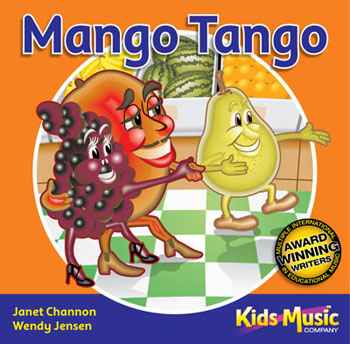
I am pleased to announce the release of a Kids Music Company (Janet Channon and Wendy Jensen) album entitled Mango Tango. I was contracted as Musical Director / Arranger for this project, but also ended up joint Co-Producer with Bruce Lynch. The musicians were (amongst others) Alex Griffith, Dixon Nacey, Lance Bentley, Ambrose Splescia, Jo Spiers and Oliver Emmitt, what a great band!! King Kapisi and Teremoana Rapley were guest vocalists on four tracks.
This album is aimed at children between the ages of 3-8 and is one of three yearly projects that will involve a collaboration between the Kids Music Company and myself. For more information about buying this album and child musical education in general please visit www.kidsmusic.co.nz and www.kidsmusiccompany.com.
Join the mango, watermelon and their juicy friends for some healthy fun; guaranteed to get you moving. Rap with King Kapisi as you try to co-ordinate a one-sided dance. Play shadows, drive a digger, dance with the dinosaurs and cook a healthy breakfast for a giant. Bulldozers, birthdays, bubbles, balls, bananas and baked beans blend with hoedown, rock, reggae, swing, tango, hip-hop and electronica. The huge variety of musical styles keeps children and adults (alike) entertained. Learning is made more fun.
I hope you all had a great holiday, I have uploaded 7 new video tracks recorded this year that can be found on www.youtube.com/mebaynes. Songs included Standards, Brad Mehldau and even some Bob Dylan!
The Watch page of my website now has new video content so have a look if you like!
Tim just completed editing his DVD “The Music is Bond… James Bond” from our recent concert in Auckland and it’s looking (thanks Vaughan and Miri) and sounding (cheers Pete) FANTASTIC.
You can check it out by clicking on the following youtube link for a small selection of the performances from Tina Cross, Taisha, Caitlin Smith, Melissa Nordhaus and the Neophonic Orchestra.
I hope you all have a great holiday, I have uploaded 7 new video tracks recorded this year that can be found on www.youtube.com/mebaynes. Songs included Standards, Brad Mehldau and even some Bob Dylan!
I shall embed some of these into my website but if you wish to get a peek at all of them then there they are.
This Ironic Trio CD is now available to purchase for the bargain price of $12 (NZ) plus p&p and can be ordered by clicking here. It is called ‘In Colour’ and features Mark Baynes (piano), Tom Dennison (bass) and Jason Orme (drumset).
Below is a link to some handouts for a jazz piano workshop that I ran for the ABRSM. Topics include voicings, change running, modes, swung quavers, nomenclature, lines & practice routine. I use these regularly in my lessons so I thought that you might find it useful. Please drop me an email on mark@jazzpiano.co.nz if you use this material, many thanks Mark
Please note that the melody is written in a simplified form, and is a guide only, embellishments & syncopation are expected.
Modes for Autumn Leaves
scales & modes are a group of notes, a pool if you like from which you can draw your ideas.
C Dorian mode (2nd mode of B flat major scale, or c major scale with lowered 3rd and 7th)
F Mixolydian mode (5th mode of B flat major scale, or f major scale with lowered 7th)
Bb major scale
Eb lydian mode (4th mode of B flat major scale, or E flat major scale with raised 4th)
A Locrian #2 mode (6th mode of C jazz minor scale, or natural minor scale with lowered 5th)
D superlocrian mode (7th mode of E flat jazz minor, also called altered and half whole scale)
G jazz minor scale (melodic minor ascending)
G dorian mode, or c mixolydian mode (same notes)
F dorian mode, or b flat mixolydian mode (same notes)
Jazz Swing Quavers
Now play the slurred notes at full value (don’t shorten) but with less emphasis.
This is an exaggerated rough guide to jazz swing feel and phrasing note length, weight of accent etc are all open to personal interpretation the shape of the melody and use of different rhythms will also determine the articulation used .
The only real way to get an idea of jazz swing is by listening to recordings made by great players.
Voicings For Autumn Leaves
Chords can be divided into 3 groups, major, minor, and dominant
Learn to recognise a major ii v i progression & the qualities of the chords involved (m7, 7, Maj7)
Learn to recognise a minor ii v i progression & the qualities of the chords involved (m7b5, 7(alt), Min7
Your chord must contain at least the 3rd and 7th (guide tones)
Build your chord from either the 3rd or the 7th upwards (there are usually 2 voicings per chord)
Avoid playing the root in your voicings
Keep movement between chords to a minimum (just like J.S. Bach!!)
Extend the m7 and maj7 chord to the 9th with the 5th
Extend the dominant chord to the 13th using the 9th (omit 5th)
Use alterations on the dominant chord especially in a minor ii v i
Nomenclature of jazz chords
There are 3 types of chord group, major, minor, and dominant. When you are reading chord charts you will need to be able to recognise which symbol belongs to which group. Often beginning improvisers get confused between a dominant chord and a major chord, whilst only a semitone different, the function of the chord is ENTIRELY different.
Here are common ways major chords are written
Here are common ways minor chords are written
Here are common ways dominant 7 chords are written
Here are the 2 ways a half diminished chord is written
Please note that jazz use extensions such as 9th, and 13th rather than 2nd and 6th to imply that the interval is ADDED to the existing chord and doesnt replace a note. e.g. C9 means a C7 plus a 2nd, Csus2 would imply that the 3rd is replaced by the 2. A C6 chord is just a c triad with the 6 added, however a C13 is a dominant chord. Jazz musicians will usually play a C7 with either a 9th or 13th anyway, so C7, C9, & C13 are the same practically.
Blues scales for Autumn Leaves
G blues – This is a good blanket scale to use when your brain aches from thinking too much!
B flat blues – you may wish to try this scale over autumn leaves, see what you think!
Change running exercises
Digital pattern exercises
1235 321 1235 321etc.
Jazz lines (ideas)
What makes a solo interesting?
Repetition, Sequence, Dynamics, Range (high, low etc), Accents, Rest and Silence, Rhythmic Variation
Variety (but not too much), Blues scale, Tension and Release, Motifs
Knowing where the guide tones are (3 and 7)
Trills, Glissandos, Swoops, Staccato etc
Emphasise pretty sounding notes, 7ths, 9ths, #4ths
Always try to buiid your solo, tell a story and make it go somewhere
Above all of this, the main thing you need to do is LISTEN, it helps swing feel, improvisation, style
and generally helps you build a solid jazz vocabulary!
What do I do now?
Practise Swing rhythms over familiar scales
Practice major 251 in both hands through cycle of 4ths, best choice
Practice major 251 in left hands through cycle of 4ths, play 251 exercise in right
hand practising swing rhythms
Seperate Chords types and practise through cycle, chromatically and randomly until
you know the chords quickly
Practise minor 251 in left hand , best choice
Practise minor 251 in left hand, play 251 exercise using Locrian #2, Superlocrian, and Jazz Minor scales
Buy a real book and play chords from any tune making yourself fluent with your new jazz voicings
Buy Jamey Aebersold backing tracks and play along either with chords & tune or try soloing
over the changes too!
Just play, be creative, listen and have fun playing jazz!
There is a huge recourse of jazz tutorial material available to buy and study, or book a series of private
lessons from a tutor, study at one of the jazz courses available in both Auckland based universities.
I have prepared this as part of my postgraduate study, my only request is that if you use it then please drop me an email to let me know. Thanks and enjoy!!
I have prepared these as part of my postgraduate study, my only request is that if you use them then please drop me an email to let me know. Thanks and enjoy!!
This is a paper that I have written highlighting the harmonic exploration of some of Brad Mehldau’s solos. I have chosen solos found in Mehldau’s contemporary repertoire from pieces as Day is Done and Riverman (both Nick Drake Covers).
In an interview with downbeat magazine Mehldau explains to Dan Ouellette, “it’s hard to talk about this without coming off as sounding pompous but I have my own voice. Without getting too technical, I have a certain way of approaching melody and harmony that some people might recognise as my own” (In Conversation with Brad Mehldau, 2008)
Brad Mehldau’s piano playing is intelligent, harmonically and rhythmically complex and unique on many levels. It is surprising therefore that there are only a handful of academic papers and other documented analysis focused on his music. This research topic is aimed at increasing the body of knowledge on the subject of Mehldau’s approach to improvisation and performance throughout his career to date. The researcher is particularly interested in these “technical” aspects of melody and harmony that Mehldau refers to. Can these be understood and applied by others? Or is it a case that Mehldau’s music is simply greater than the sum of its individual parts?
Due to time constraints, the researcher hopes to analyse two elements of Mehldau’s playing during the period of one academic year. These two contrasting topics are listed below and have been purposely chosen to provide research based on both specifically focused, and also a more general analysis.
With particular reference to Radiohead, Nick Drake and the Beatles, what are the harmonic improvisational approaches to Mehldau’s adaptation of pop songs? Can these approaches be formalised and applied to other vehicles? This is quite a specific topic and hopes to draw conclusion from analysis of a very small section of music, namely Mehldau’s contemporary repertoire.
I have finally got around to uploading a couple of recently recorded trio tracks with Jason Orme and Tom Dennison, a 10 minute version of Autumn Leaves and Dolphin Dance recorded by Mainz at the Lewis Eady Charitable Trust concert last month.
You can listen to them on the Listen page of this website.
Georgia Funk Every Sunday in June (Soul on Sunday)
A Dynamic Groove Quartet
An evening of funk, blues, jazz and old school RnB at Manuwera Cosmopolitan Club, Auckland
Band : Mark Baynes (keys), Alex Griffith (bass), Lance Bentley (drums), Georgia Wood (Vox)
3pm-7pm every Sunday in June
One weeks ship contract, should be fun and just like old times!
Ship: P&O Pacific Sun
Position: Piano sideman in the showband
Dates: 5/27/09-6/04/09 (embarking in Brisbane, disembarking in Auckland, via New Caledonia and Vanuatu).
Georgia Funk Every Sunday in June (Soul on Sunday)
A Dynamic Groove Quartet
An evening of funk, blues, jazz and old school RnB at Manuwera Cosmopolitan Club, Auckland
Band : Mark Baynes (keys), Alex Griffith (bass), Lance Bentley (drums), Georgia Wood (Vox)
3pm-7pm every Sunday in June
Georgia Funk Every Sunday in June (Soul on Sunday)
A Dynamic Groove Quartet
An evening of funk, blues, jazz and old school RnB at Manuwera Cosmopolitan Club, Auckland
Band : Mark Baynes (keys), Alex Griffith (bass), Lance Bentley (drums), Georgia Wood (Vox)
3pm-7pm every Sunday in June
Georgia Funk Every Sunday in June (Soul on Sunday)
A Dynamic Groove Quartet
An evening of funk, blues, jazz and old school RnB at Manuwera Cosmopolitan Club, Auckland
Band : Mark Baynes (keys), Alex Griffith (bass), Lance Bentley (drums), Georgia Wood (Vox)
3pm-7pm every Sunday in June
My latest assignment is a transcription of a Clifford Brown solo from a recording of ‘I’ll Remember April’.
Below is an excerpt and a link to the full analysis:-
The assigned material for this topic is a Clifford Brown transcription of his trumpet solo during the performance of the standard entitled “I’ll Remember April”, originally recorded in 1956. The solo was transcribed by David Baker and presented to us in Bb pitch, matching the transposition of the instrument it was performed on. I shall be analysing the solo at concert pitch however so that the notes sound correct if played on a keyboard instrument or other non-transposing sound source.
Before analysis can begin it is important to correct errors from the original transcription. The following pages contain the complete excerpt (entitled A) with all the significant notational and rhythmical errors highlighted. These errors have then been corrected in excerpt B, and it is excerpt B that I shall then refer to when discussing my musical analysis.
The analysis itself shall be split into two sections. The first section shall deal with improvisational devices used on this 98 bar solo, it shall be a “bar by bar” account if you like of Clifford Browns improvisational methodology. It will include a table of musical devices as an appendix to the section.
The second section will discuss the solo on much broader terms, drawing the attention to the phrasing, dynamics, tone, density, style and overall direction of the solo played by one of the most acclaimed and influential trumpet players of the era.
Clifford Brown Transcription Analysis (Contact me for this PDF directly and I will email it to you)
An evening of funk, blues, jazz and old school RnB at Grand Central bar, Ponsonby, Auckland
Band : Mark Baynes (keys), Alex Griffith (bass), Lance Bentley (drums), Georgia Wood (Vox)
10pm-1am
People sometimes ask me what keyboards I use to teach and gig with, so I thought I would just post a list so here you go:
Nord Stage 88 – The ultimate gigging keyboard for those whose enjoy the more “retro” sound. The stage provides you with an abundance of classy Rhodes, Wurlitzer, Clav, Piano and Hammond sounds. I generally perform with this keyboard.
Yamaha CP70 – An electric Grand Piano made in the 70s before digital reproductions became commonplace. This instrument is very heavy for a portable gigging machine hence the reason I only use it at home. This instrument is a collectors item as its almost impossible to find 2nd hand Electric Grand Pianos these days.
Fender Rhodes – Suitcase model. This ‘almost mint condition’ Rhodes spent much of its time at Revolver Studios in Auckland before moving to my home. This is probably one of the best examples I have ever seen, and it stays at home to keep it that way.
Hohner Clavinet D6 – This needs a little work, I’m planning to replace the strings and upgrade the preamp so that it’s quieter, a work in progress. However this is a very rare keyboard made famous by Stevie Wonder who used it to help create his staple sound.
Juno 106 – Mine is in mint condition and is useful for analogue pad sounds and the occasional lead. One of the last analogue keyboards ever made.
1990 Hubbard after Moermans 1584, Single Manual Harpsichord – A great sounding Harpsichord, designed to be portable and used as a ‘gigging’ instrument. I don’t have too many gigs that require it but you never know!
Haake Upright Piano – An 88 note fully weighted practice / teaching piano. Built in the 90’s and well maintained / tuned twice a year.
Georgia Funk – An exciting and dynamic groove quartet! Georgia Funk is a retro-based funk, soul and old school RnB outfit playing songs by Aretha Franklin, Stevie Wonder, Herbie Hancock, Marvin Gaye, Bill Withers and more!
An evening with Georgia Funk will get you dancing and grooving your socks off! But that’s not all, Georgia Wood’s powerhouse vocals cut through the air leaving listeners with no doubt to her vocal prowess.
Jazz pianist Mark Baynes and 6-string bassist Alex Griffith also carve up exciting and tasteful improvisation, the end result is uplifting as these classic songs take on a new lease of life. The Lineup includes (but is not limited to) Georgia Wood (Vox), Mark Baynes (Keys), Alex Griffith (Bass) and Lance Bentley (Drums). Currently residing at the Grand Central Bar (126 Ponsonby Road) every Friday 10pm till late.
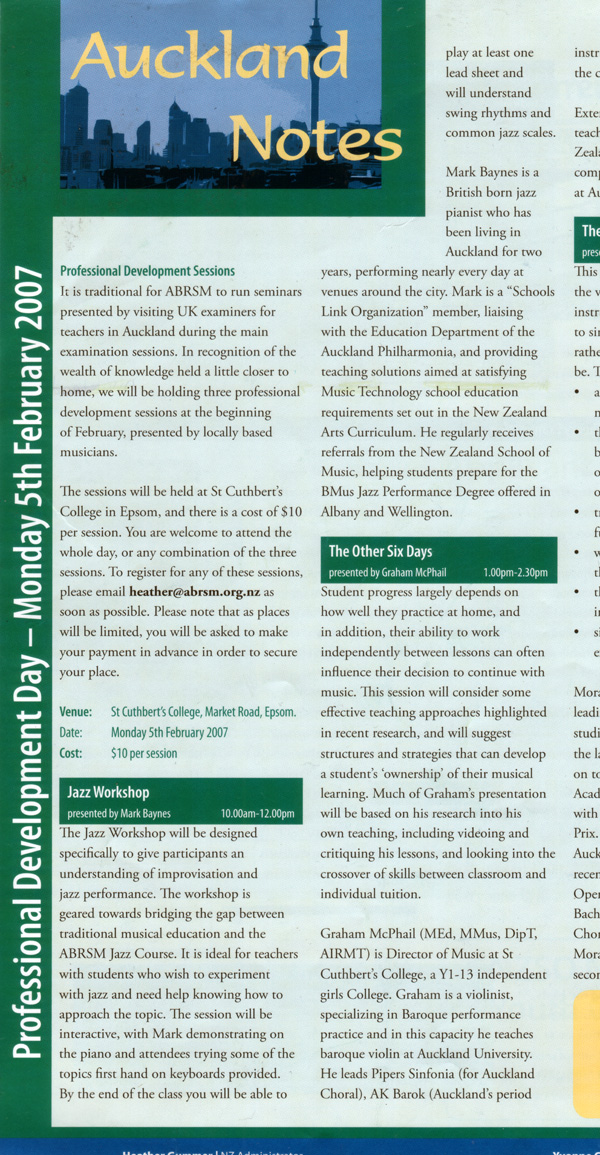
The Jazz Workshop will be designed specifically to give participants an understanding of improvisation and jazz performance. The workshop is geared towards bridging the gap between traditional education and the ABRSM Jazz Course. It is ideal for teachers with students who wish to experiment with jazz and need help knowing how to approach the topic. The session will be interactive, with Mark demonstrating on the piano and attendees trying some of the topics first hand on keyboards provided. By the end of the class you will be able to play at least one lead sheet and will understand swing rhythms and common jazz scales.
Mark Baynes is a British born jazz pianist who has been living in Auckland for two years, performing nearly every day at venues around the city. Mark is a “Schools Link Organisation” member, liaising with the Education Department of the Auckland Philharmonia, and providing teaching solutions aimed at satisfying Music Technology school education requirements set out in the New Zealand Arts Curriculum. He regularly receives referrals from the New Zealand School of Music, helping students prepare for the BMus Jazz Performance Degree offered in Albany and Wellington.
I can’t take all of the credit for this, my talented fiancee Arianwen Thomas designed the original logo and we had help from Glen French (www.glenfrench.co.nz) who helped me settle on a final design. It will appear on the website as soon as I can work out how!
A university essay comparing Brazilian Like and Brazilian Suite. Both compositions were written by the french jazz pianist Michel Petrucciani and contain many musical similarities.
I am a reading and improvising professional Pianist / Keyboard Player, and have over 10 years of international experience playing for blue chip clients such as the Hilton Chain, Seabourn Luxury Yachts, the ‘All Blacks’ Rugby Team, Hayley Westrena, and the BBC. I regularly play with of some Aucklands leading jazz outfits and have enjoyed working with quality acts such as Battucada Sound Machine, King Kapisi, Don McGlashan, Anika Moa, Annie Crummer, and Tama Waipara. I have been broadcast on Homegrown on C4, Juice and Alt TV. I have taught piano and jazz for 5 years for institutions such as the New Zealand School of Music, ABRSM, Corelli School of the Arts, and privately, from my home.
Now you can subscribe to my website, this will keep you informed of any updates to gigs or other info on the site. You can find the link on the right or just here.
Thanks for visiting this site, it is very young however, and I’m still trying to work out how to use WordPress but bear with me and it will be just fine!